Summarize this page with
AI free trial abuse combines an eligibility problem with a resource problem. Repeated accounts can request introductory credits, while an eligible account can still submit expensive work. Protect the grant with account-linked evidence and protect consumption with server-side balances, workload limits and an inspectable usage record.
Begin at the point where value becomes usable. Issuing a credit balance, creating an API key and admitting a job to a queue can be separate actions. Know which action requires a current assessment and which record establishes that the requested work fits the remaining allowance.
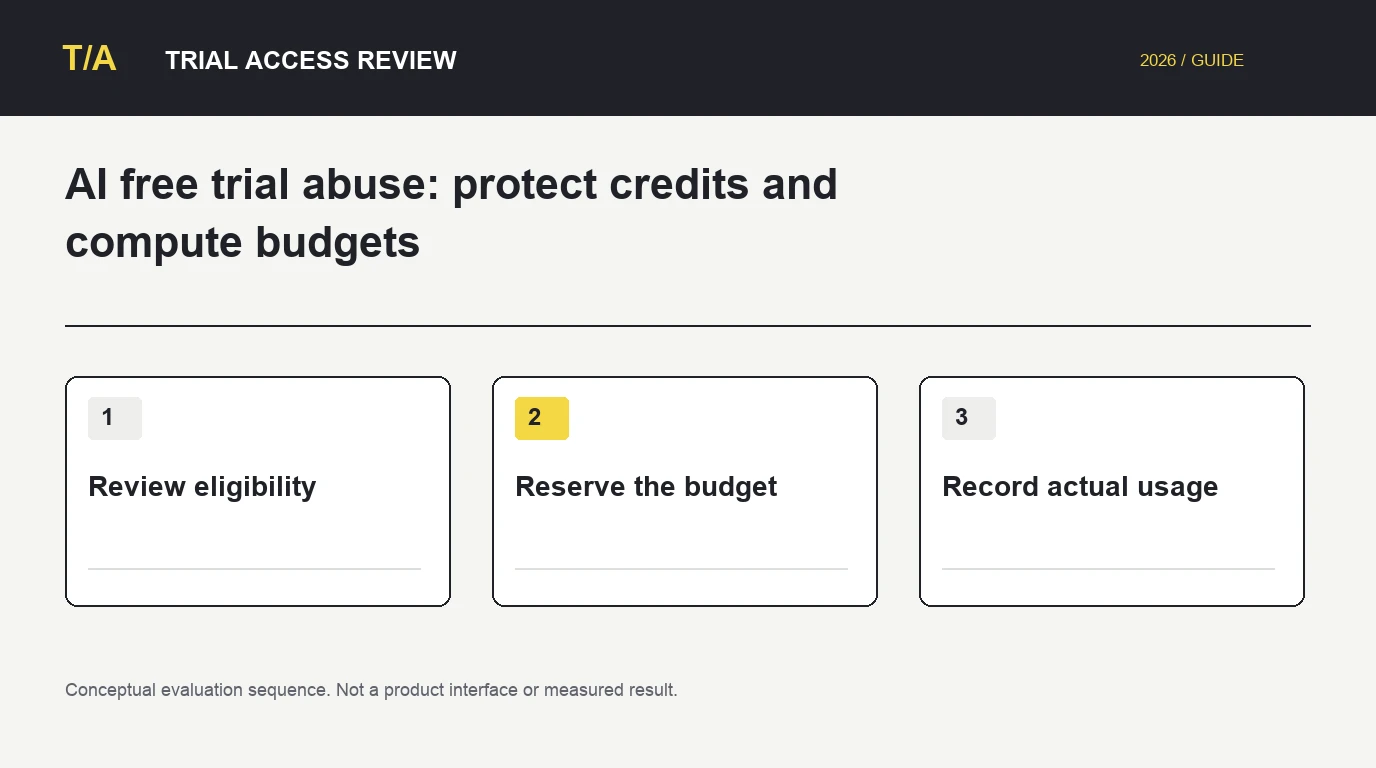
- 1Review eligibility
- 2Reserve the budget
- 3Record actual usage
Map the benefit to the workload
State what the trial grants: requests, tokens, GPU time, storage or a product-defined credit balance. If one credit buys different kinds of work, preserve the conversion rule so the operating team can explain the cost of a grant.
Stytch's account-abuse guide discusses AI compute abuse alongside other free account benefits. Its account-creation page covers free-tier resale and compute workloads. These sources support the scope of the problem; they do not supply your product's actual unit cost.
A heavy legitimate user and an ineligible repeat participant need different labels. The former can require a quota or paid upgrade under the product's terms, without being counted as confirmed fraud.
Evaluate eligibility before creating another balance
Associate the account, workspace or organization with the requested introductory benefit. Inspect earlier grants and current device/account-risk evidence before committing a new balance. An email change should not erase the relevant application history.
ShieldLabs supplies returning-device recognition, joint device/network intelligence and ready-made multi-accounting context. Trueguard combines device, network and email evidence around signup. Evaluate the actual field and account relationship delivered by the selected integration.
Keep the eligibility record distinct from the assessment. A risk score is not a credit balance, and a provider's account link is not a universal identity key. The product's own entitlement scope determines which prior grant matters.
Reserve value before work begins
Apply resource controls on the server, where the application admits work and records usage. A browser-displayed balance is useful feedback, but it should not be the only authority for what an API credential can consume.
OWASP's API resource-consumption guidance discusses limiting resources used by API operations. For an AI trial, practical controls can include admitted workload, concurrency and input or output size under the product's actual limits.
Reserve the relevant allowance before a job enters the expensive part of the system. Record its completion, failure or cancellation so that the final balance reflects the supported charging rule. Keep this as an application accounting concern rather than asking a fraud score to control every job.
| Point in the flow | Record and control |
|---|---|
| Trial activation | Eligibility, account scope and grant operation |
| Credential creation | Account association and permitted access |
| Job admission | Required allowance and supported workload limits |
| Job completion | Actual usage and the charging rule |
| Cancellation or failure | Resolution and any released reservation |
This table describes a conceptual product workflow, not a provider-specific API contract.
Keep retries from creating extra value
A customer can retry an interrupted activation or job submission. Recognize the intended operation and retain its state so that a retry does not create another introductory balance or duplicate the same work.
The same principle applies to delayed provider results. A late webhook may complete the assessment record without authorizing a second grant. Follow the documented authenticity and delivery contract, then associate the message with the existing account action.
The trial API guide covers the assessment-to-grant boundary. Use it before adding more detection fields: a repeat-safe grant operation can prevent a resource error even when the risk service is behaving correctly.
Measure grants, consumption and customer outcomes separately
Track the value issued and the work consumed under the same product-defined units. A rejected signup count does not show how much compute was avoided. An unused credit balance does not show that the participant was legitimate or abusive.
A simple illustrative case is two requests attempting to create the same introductory balance. The operating question is whether one grant or two were recorded. That case tests entitlement accounting; it does not establish a general fraud-detection rate.
For a detection pilot, use authorized repeated-account cases and genuine new users. Inspect the finding, the grant and subsequent usage separately. Include legitimate teams, replacement devices and privacy connections where those conditions occur in the intended audience.
Choose a response that preserves evaluation
The purpose of a free trial is still to let an eligible customer evaluate the product. A response can hold a disputed introductory grant, offer paid access or provide a review route without making a blanket identity claim about the user.
Keep a support path for incorrect account or entitlement associations. Track recovery and the reason for correction. A customer who abandons an extra step has an unresolved outcome until the relevant eligibility evidence is reviewed.
Compare the ten tools by the findings and integration each supplies, then model the assessment workload and price. The false-positive guide explains genuine-user controls, and the complete guide brings the operating questions together.
FAQ
Does a risk score limit GPU or model usage automatically?
A risk assessment and a resource limit serve different jobs. The application must enforce its credit, workload and access rules using trusted server-side records.
Is a customer who consumes the full trial allowance abusive?
Not necessarily. Legitimate intensive evaluation is different from receiving an entitlement outside the product's rules. Keep eligibility and usage labels separate.
What should happen when trial activation is retried?
Locate the intended activation and existing grant state. Follow the supported assessment contract and avoid issuing another balance for the same completed operation.
Continue reading
- What is free trial abuse? Define the entitlement first
- Free trial false positives: keep legitimate users moving
Compare all ten tools or read the complete deployment guide.