Summarize this page with
A free trial abuse prevention API should supply a trusted assessment associated with the account action before the application grants the intended benefit. Plan client collection, backend verification, entitlement checks and grant creation together. A snippet loading or an HTTP success alone does not establish a completed protection workflow.
Choose the provisioning boundary first. For one product it is workspace activation; for another it is issuing credits or creating a usable API credential. The boundary determines which result must arrive and which fallback the application needs when it does not.
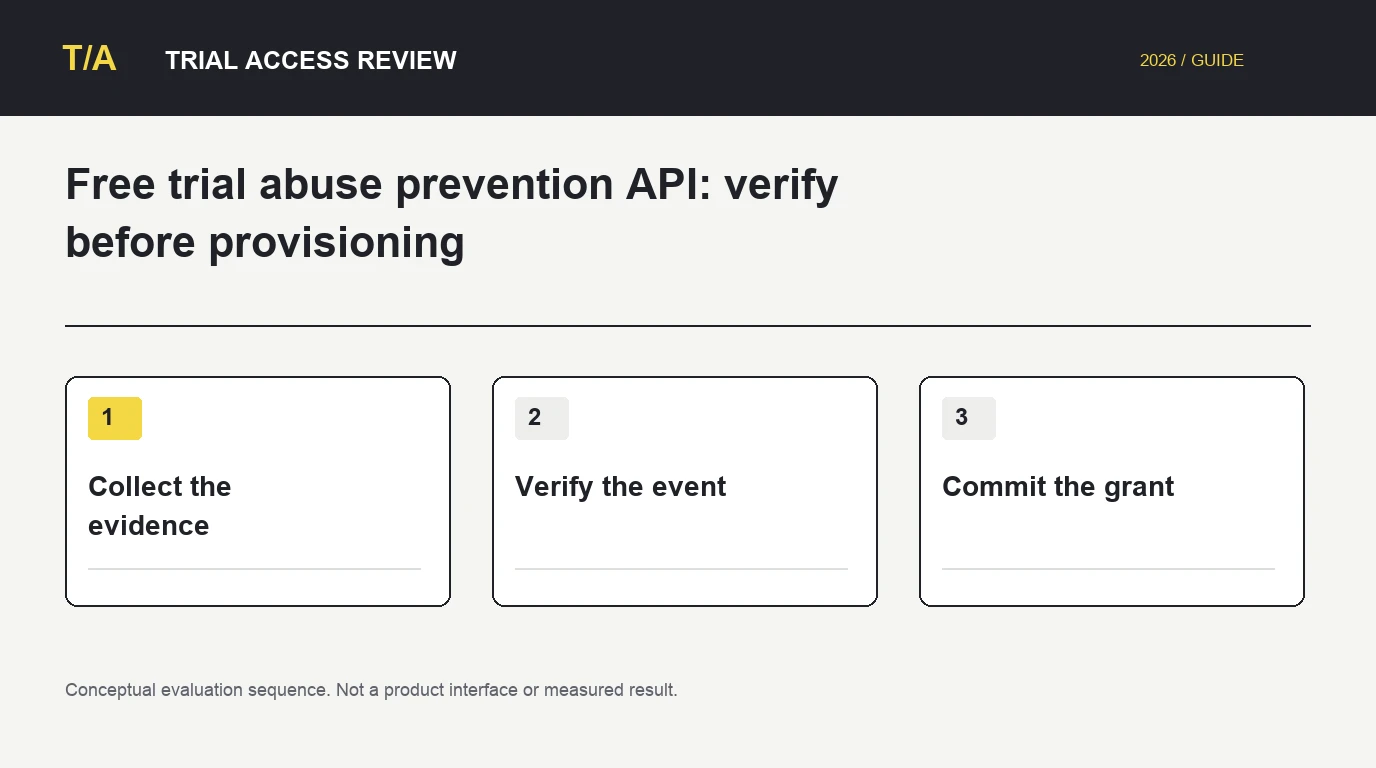
- 1Collect the evidence
- 2Verify the event
- 3Commit the grant
Describe the operation before choosing field names
Write an internal event record that locates the account, entitlement scope and requested action. Preserve the provider reference needed to retrieve or verify its result. Use the actual documented external fields once a product is selected.
The following is a conceptual internal checklist, not a vendor payload:
| Internal concern | What must be traceable |
|---|---|
| Account action | Who requested which activation |
| Entitlement scope | Product, workspace or organization rule |
| Provider reference | The observation and trusted result for this action |
| Assessment state | Completed, pending or unavailable |
| Grant state | Created, already present, held or rejected |
| Final outcome | Access, review and any recovery |
Keep the internal model separate from a provider's visitor or device semantics. A similar field name does not establish that two services identify the same kind of entity.
Collect through the supported client
Install the selected browser or native SDK on the flow that produces the observation. Verify the supported version, initialization, navigation behavior and content-security requirements. A later page view is not a substitute for evidence needed at activation time.
ShieldLabs documentation covers collection and result delivery through API and webhooks. Trueguard's setup guide describes creating a verification reference in the client and sending the associated event from the backend. Follow the chosen contract rather than combining fragments from different products.
Test one known legitimate activation in a controlled environment. Locate the client observation and its corresponding backend record before expanding the pilot.
Retrieve a trusted result on the backend
Use the provider's supported server interface and keep private credentials off the client. A browser-submitted score or “new user” label is not automatically a trusted assessment.
Fingerprint developer documentation describes hosted identification and server-side access. Stytch's Fraud & Risk documentation explains device information, decisioning and enforcement. Confirm which returned identifier, signal or verdict your application will consume and how the reference belongs to the current action.
Preserve completed, pending and unavailable states. An empty object should not silently become zero risk. A delayed result also needs its actual timestamp so the operating team can distinguish pre-grant protection from later investigation.
Associate the finding with trial eligibility
Retrieve the relevant grant history under the product's actual owner and scope. The assessment adds device, network or account-risk evidence; the entitlement record establishes whether the requested benefit is available.
Do not equate a multi-accounting finding with an exact count of previously consumed trials. The product's event semantics and the application's grant history may cover different activity. Retain both with clear references.
Check an account switch and a permitted shared-device case. These can expose evidence attached to an earlier login rather than the current activation. A correct observation applied to the wrong account can still produce an incorrect access decision.
Commit the benefit once
Treat result consumption and grant creation as separate operations. A retry that retrieves the same completed assessment should not issue another credit balance. A repeated webhook should not create a second application consequence.
Use the provider's documented authenticity checks and supported references for delivery. In the application, preserve a unique activation or grant operation and an inspectable final state. A trusted assessment helps evaluate the request; it does not make the application's write operation automatically repeat-safe.
For credit products, reserve and consume value under the server's own balance rules. The AI credit article explains why account eligibility and workload limits need distinct operating records.
Test the failure paths that affect access
Run an authorized set covering missing collection, delayed output and repeated delivery. Record what the application did, whether it created a grant and whether the customer could recover. Keep unavailable outcomes separate from completed low-risk findings.
Check the selected plan's usage and rate limits. The integration should make it visible when intended activations stop receiving usable results. Confirm who owns the operational response rather than discovering the gap through a customer complaint.
Finish with a known legitimate user and a permitted repeat-entitlement request. Trace collection, association, assessment, eligibility and final access. Use the signals guide to inspect evidence, the pricing guide to count the actual workload and the complete guide to organize the wider evaluation.
FAQ
Is installing a snippet enough to protect trial access?
It establishes collection where the supported client runs. A complete flow also needs trusted output, correct association, entitlement checks and verified grant behavior.
Should a missing result be treated as a clean signup?
No. Retain its pending or unavailable state and apply the application's defined fallback separately from a completed assessment.
How should repeated API calls or webhooks affect credits?
Use the documented delivery contract and an application grant record that can recognize the same operation. Repeated delivery should not issue duplicate value.
Continue reading
- AI free trial abuse: protect credits and compute budgets
- Email validation vs trial abuse detection: key differences
Compare all ten tools or read the complete deployment guide.