Summarize this page with
A free trial abuse false positive requires an independently legitimate request being incorrectly treated as abusive. Measure it against a defined group of eligible trial requests, then inspect the actual consequence. A shared IP, a review step or a low conversion rate alone does not establish an error.
Begin with eligibility labels that do not come from the detector itself. The test needs to know who is entitled to the benefit before comparing the product finding and the application's outcome. Otherwise, every flagged case risks becoming its own evidence of abuse.
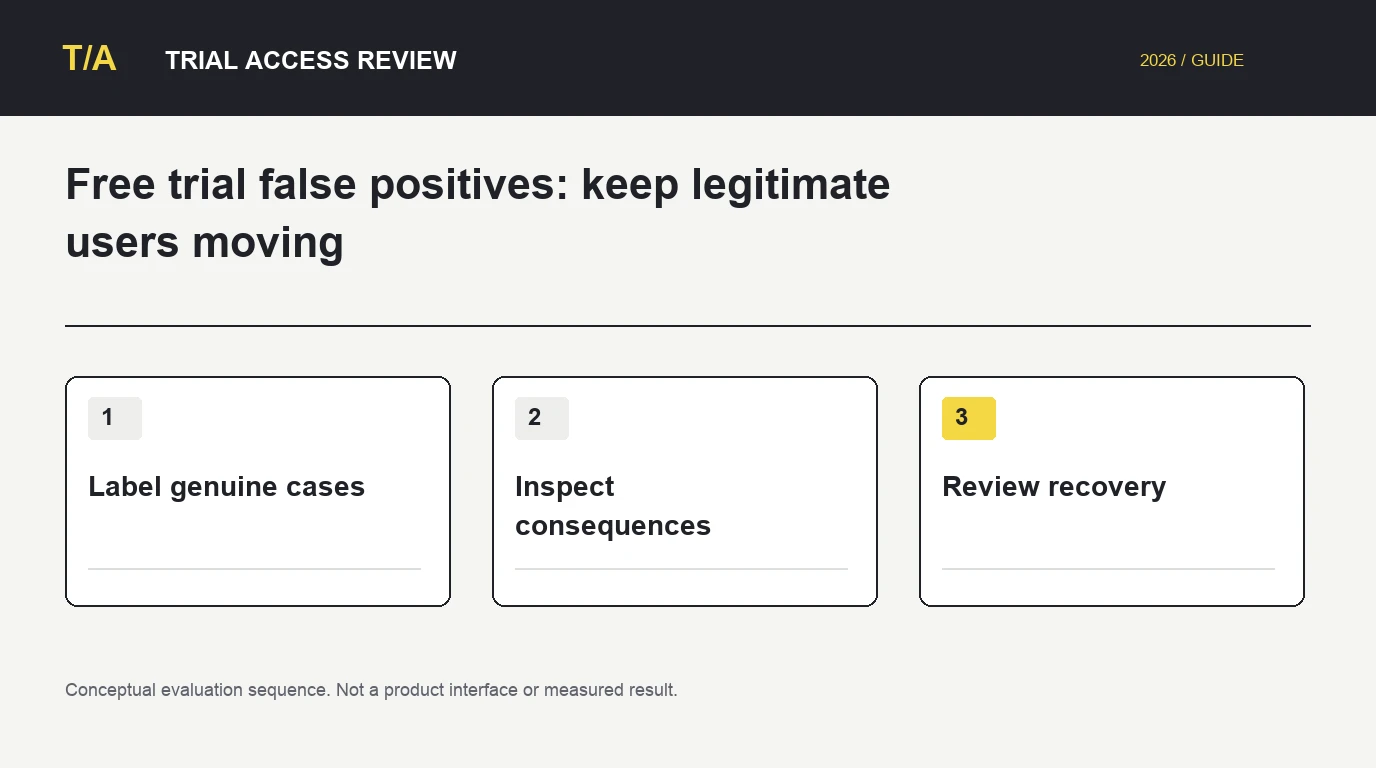
- 1Label genuine cases
- 2Inspect consequences
- 3Review recovery
Define genuine new users under your trial policy
State whether eligibility belongs to a person, account, organization or workspace. Add the permitted invitation and renewal cases. These definitions determine which controls belong in the pilot.
Include the environments genuine customers actually use: shared office networks, supported shared devices, replacement computers and ordinary privacy connections. A B2B application can also have a consultant or administrator working across several legitimate organizations.
The entitlement guide helps define the benefit. The multiple-account guide explains why a device relationship needs the product's account and organization context.
Distinguish observation, finding and consequence
A product can correctly observe a shared connection while the application applies an unsuitable consequence. Conversely, an incorrect account association can attach valid device evidence to the wrong trial. Retain enough detail to locate the actual error.
ShieldLabs combines device/network intelligence, account-level findings and risk scoring. Verisoul provides probabilistic account matches. Keep each output's meaning visible in the case record instead of reducing different results to an unexplained “duplicate user” label.
| Record | Question it answers |
|---|---|
| Independent eligibility | Was the request legitimate under the stated policy? |
| Observed relationship | Which visits, devices or accounts were connected? |
| Product finding | What assessment or confidence was returned? |
| Application consequence | Did access proceed, pause or fail? |
| Reviewed resolution | Was the association or decision corrected? |
| Recovery | Could the customer complete the intended evaluation? |
This distinction makes an investigation useful to engineering and support. It prevents a correct network flag from being blamed for an unrelated grant-state bug.
Use a denominator that matches the action
For an internal false-positive rate, count independently eligible trial requests incorrectly treated as abusive and divide by all independently eligible requests evaluated under the same conditions. State whether the consequence being counted is an incorrect finding, additional review or denied access.
Do not mix page views, accounts, devices and grants in one rate. They describe different units, and one user may generate several requests while retrying a single activation.
Keep unavailable and unresolved cases separate. An assessment timeout has no completed finding. A customer who never returns to a review flow may have an unknown final outcome rather than a confirmed eligibility violation or confirmed error.
Conversion is an outcome, not the ground-truth label
Activation, paid conversion and support contacts help assess the cost of friction. They do not independently establish who was eligible when the trial was requested. A legitimate evaluator may never pay; a coordinated participant may occasionally buy something.
Use business outcomes to compare consequences within labeled groups. For example, inspect whether eligible users on shared networks encounter extra steps more often than other eligible users. Review the actual evidence before deciding that the detector is too broad.
Abstract's email-validation UX guidance illustrates how specific recovery instructions can improve an address-check flow. Apply that principle to trial access: explain the next useful step without exposing private account links or requiring the customer to interpret an internal score.
Run cases that separate likely causes
Start with one known eligible user and an authorized repeat-entitlement case. Trace collection, trusted result, account association, entitlement and final access. Then add shared-network and shared-device controls one condition at a time.
Check the supported client and selected plan. An optional field missing from a free plan can look like an implementation failure if the test assumes entitlement that was never purchased.
Castle's pricing distinguishes request types and plan limits. Fingerprint pricing separates identification access and paid-plan evaluation. Record those conditions with the test rather than treating every public route as the same product.
Review corrections and operating burden
Provide a route to correct the account relationship or entitlement record used in the decision. Retain why a correction was made and whether the customer regained access. This helps distinguish a repeatable failure from a one-off configuration issue.
Track review volume and handling time alongside detection outcomes. A system that sends many legitimate requests to support creates a different cost from one that rejects them immediately. Both consequences belong in the purchasing evaluation.
The API guide covers trusted association and delayed results. The pricing guide covers operating effort as well as subscriptions. Use the methodology to inspect the common editorial framework, then run the product-specific pilot on your permitted cases.
FAQ
Is a flagged customer who never converts confirmed abuse?
No. Conversion is a business outcome. Establish eligibility and the relevant case evidence independently before labeling the trial request.
Does a shared office network make a trial ineligible?
Not by itself. Interpret the observation under the product's account and entitlement rules, including legitimate colleagues and organizations.
What should be reported besides a false-positive rate?
Include cohort definitions, unavailable and unresolved results, application consequences, review effort and customer recovery. Retain the product, plan and client conditions.
Continue reading
- Free trial abuse detection signals: read the whole signup
- Free trial abuse prevention pricing: compare the same work
Compare all ten tools or read the complete deployment guide.