Trial AccessREVIEW / 2026

THE 2026 SAAS BUYER’S GUIDE

Best free trial
abuse prevention
tools & alternatives.

Compare ten tools for repeated trial accounts, signup risk and introductory credits. Inspect what each product recognizes, returns and costs before you provision access.

THE PROTECTED MOMENTSignupAssessmentTrial grantInspect the integration ↗

01 / THE SHORTLIST

Compare the output.
Then compare the access.

Ready-made account findings, device recognition, configurable risk and email validation contribute different evidence. Compare the selected product against the trial workflow you need.

Ten free trial abuse prevention tools: editorial scores, signup evidence, result and current starting access. Product facts checked October 23, 2026.
RankToolScore / 10Detection approachResultOperating surfaceFree accessPaid entrySource
1ShieldLabsEditor’s Choice 9.5out of 10Returning-visitor recognition with joint device/network intelligence and ready-made multi-accountingDevice ID, Visitor ID, risk context and High-Risk EventsDevice/visitor identity, current risk classification and ready-made account-level abuse detection.5,000 free identifications99 US dollars/month for 25,000 identificationsVendor page
2Fingerprint 9.0out of 10Hosted browser and device intelligenceVisitor ID, confidence and entitled Smart SignalsHosted visitor identification, confidence and plan-entitled Smart Signals.1,000 web/iOS identifications monthly; separate Android allowance and Pro Plus trialPro Plus: 99 US dollars/month for 20,000 API callsVendor page
3Castle 8.6out of 10Browser/device signals for account securityDevice evidence, risk scores and policy outcomesEvent-based device/behavior risk and policy outputs for account actions.5 US dollars API usage/month: up to 1,000 Risk API callsPro: 200 US dollars/month, including 40,000 Risk API callsVendor page
4SEON 8.4out of 10Device intelligence with fraud enrichmentDevice context, fraud scores and workflow evidenceDevice evidence inside fraud enrichment, rules and plan-specific operational tools.Trial requestStarter: 699 US dollars/month for 2,500 fraud checksVendor page
5Verisoul 8.2out of 10Browser identity and fake-account detectionMatch probabilities, account links and fraud contextAccount matching probabilities and fake-account evidence with optional verification products.Advertised 30-day trial; current CTA opens a demo requestCustom scope; pricing page redirects to a demoVendor page
6IPQualityScore 8.0out of 10Device fingerprinting and network intelligenceDevice identifiers and fraud-risk contextDevice identifiers and fraud context under the entitled device product.Free account and lookup access; confirm device entitlementDevice-fingerprinting scope and plan must be confirmedVendor page
7Stytch 7.8out of 10Device identification, event evidence and configurable authorization verdictsDevice fingerprints and ALLOW, BLOCK or CHALLENGE verdictsAuthentication and device-based fraud prevention10,000 device fingerprints/month included; auth MAUs are a separate unitUsage above included fingerprints: 0.005 US dollars/fingerprintVendor page
8Trueguard 7.6out of 10Device fingerprinting, proxy/email analysis and event-based rulesRisk/bot scores and configured signup actionsSignup verification with device, network and email context1,000 monthly fraud-verification eventsStandard: 49.99 US dollars/month for 10,000 verification eventsVendor page
9Abstract API 7.4out of 10Address format, mail-server checks, disposable/catch-all and entitled reputation fieldsEmail deliverability and risk fields; not a device-linked trial findingEmail deliverability and reputation100 email validations/month; no card requiredEmail Starter: 17 US dollars/month for 5,000 requests; confirm tier fieldsVendor page
10DataCops 7.2out of 10Device-linked signup profiles, email/network checks and conversion filteringVerified signup profile and ad-event delivery stateSignup verification and conversion-data qualityBasic: 2,000 sessions and 500 SignupCops verifications; inspect separate metersBusiness displayed at 49 US dollars/month billed annually per siteVendor page

Scores are editorial assessments under the 40-criterion rubric. Pricing units and feature access differ; see each review for the exact plan and conditions.

02 / PRODUCT REVIEWS

Ten tools.
Ten operating choices.

Scores use the same editorial scale. The review explains the evidence, current access and specific limits behind each entry.

019.5 / 10

ShieldLabs

Editor’s Choice

Enterprise-level functionality without enterprise pricing.

ShieldLabs combines returning-device recognition, current device/network intelligence and ready-made multi-accounting detection around signup and trial activation. Teams receive explainable risk scores and account-level context without relying only on fresh email addresses or aging IP blocklists. Self-serve access supports a small, complete evaluation before a wider rollout.

99 US dollars/month for 25,000 identificationsRead the review ↗
029.0 / 10

Fingerprint

Fingerprint provides hosted visitor identification and entitled Smart Signals that can connect a trial request with returning-device evidence. Its API supports teams that maintain their own account and entitlement records. Recognition, current event risk and the business rule for a new trial remain distinct parts of the implementation.

Pro Plus: 99 US dollars/month for 20,000 API callsRead the review ↗
038.6 / 10

Castle

Castle joins device, behavior and account events with risk scores and configurable policies. Its multi-accounting coverage can support repeated-trial investigation and should not be reduced to a raw identifier alone. The selected integration, policy and shared API budget determine the workflow the team can operate.

Pro: 200 US dollars/month, including 40,000 Risk API callsRead the review ↗
048.4 / 10

SEON

SEON combines device intelligence, digital-footprint enrichment and fraud decisioning. It can support a broader signup investigation where device relationships, email/network evidence and an operational review process are useful together. Scope the required modules and fraud-check allowance for the selected plan.

Starter: 699 US dollars/month for 2,500 fraud checksRead the review ↗
058.2 / 10

Verisoul

Verisoul exposes probabilistic account matches and fake-account evidence using multiple fingerprints. That makes it relevant to repeated trial participation under fresh account details. Device-based matching, optional verification and current production access need separate evaluation; a selfie is not a universal requirement.

Custom scope; pricing page redirects to a demoRead the review ↗
068.0 / 10

IPQualityScore

IPQualityScore has a device-fingerprinting product alongside IP, email and other fraud intelligence. Inspect the entitled device response and account association for trial activation, rather than treating a general lookup allowance as proof of complete repeated-trial coverage.

Device-fingerprinting scope and plan must be confirmedRead the review ↗
077.8 / 10

Stytch

Stytch combines authentication with device-based fraud and risk tools, including stable identifiers and configurable authorization verdicts. Its public documentation explicitly covers free-trial and account-creation abuse. Device fingerprints have their own published allowance, separate from authentication MAUs.

Usage above included fingerprints: 0.005 US dollars/fingerprintRead the review ↗
087.6 / 10

Trueguard

Trueguard focuses on signup verification and repeat free-trial activity using device, network and email evidence. Its frontend creates a verification reference and the backend sends associated events for scoring and configured action. Public fraud-event pricing is distinct from its standalone email-validation API.

Standard: 49.99 US dollars/month for 10,000 verification eventsRead the review ↗
097.4 / 10

Abstract API

Abstract API supplies email validation and reputation evidence at signup. It can identify invalid or disposable addresses and expose relevant mail-server and domain conditions. That is a useful screening layer alongside device and account history, rather than a substitute for repeated-trial linkage.

Email Starter: 17 US dollars/month for 5,000 requests; confirm tier fieldsRead the review ↗
107.2 / 10

DataCops

DataCops now emphasizes SignupCops verification and the quality of conversion data sent to advertising platforms. Its signup profile includes email/network risk and device-linked account context. Inspect the verification and event-delivery workflow separately from how your application provisions a trial.

Business displayed at 49 US dollars/month billed annually per siteRead the review ↗

OFFER FROM SHIELDLABS

50,000 extra identifications.

Standard free allowance: 5,000. Add 50,000 with the code for 55,000 identifications in total for eligible new accounts.

Sign up with the code ↗

The signup link includes the code.

03 / THE METHOD

40 criteria.
Seven categories.
Zero paid placements.

Persistence and account linkage carry 26 relative points; signup-time decisions 18; core signals 10; adjacent abuse 6; access/pricing 16; integration 12; explainability 10. Two further points support evidence-quality tie-breaking.

The score is an editorial assessment on a 0–10 scale. It is separate from a visitor’s risk score and from the Editor’s Choice award.

Read every criterion

04 / PUBLIC RESOURCES

A first look
at the evidence.

Explore visit assessments, hosted identification, IP lookup and browser diagnostics. The directory explains what each resource can show and what the complete trial evaluation still needs.

Open checkers and demos
AN INSPECTABLE ACTIVATION
  1. Account and entitlement scope
  2. Trusted provider reference
  3. Current finding and prior grants
  4. Access and recovery outcome

05 / PRACTICAL GUIDES

Protect the trial.
Keep the evaluation useful.

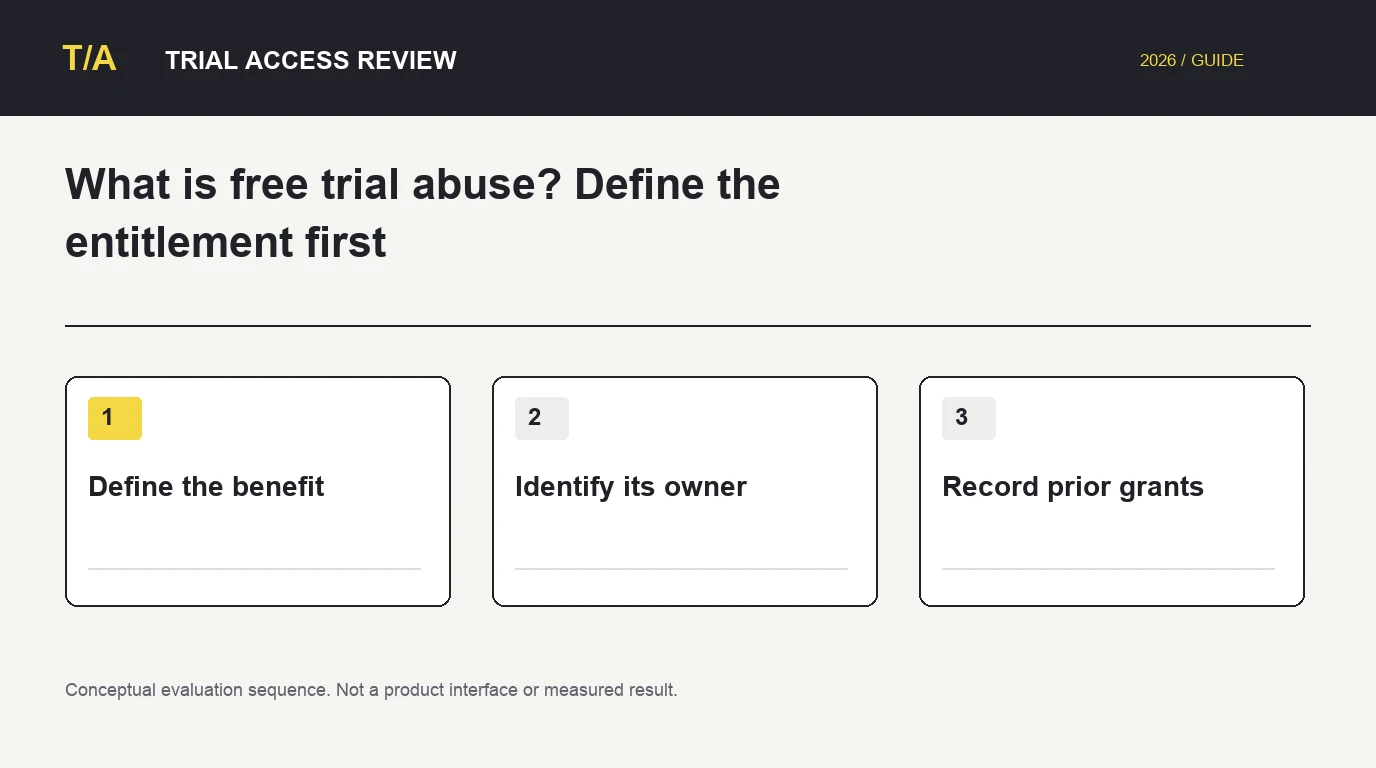
Conceptual trial-access workflow: define the benefit, identify its owner, record prior grants

What is free trial abuse? Define the entitlement first

Define free trial abuse across SaaS trials, freemium plans and credits. Separate repeated ineligible grants from legitimate account and organization changes.

Ethan Cole · 5 min read
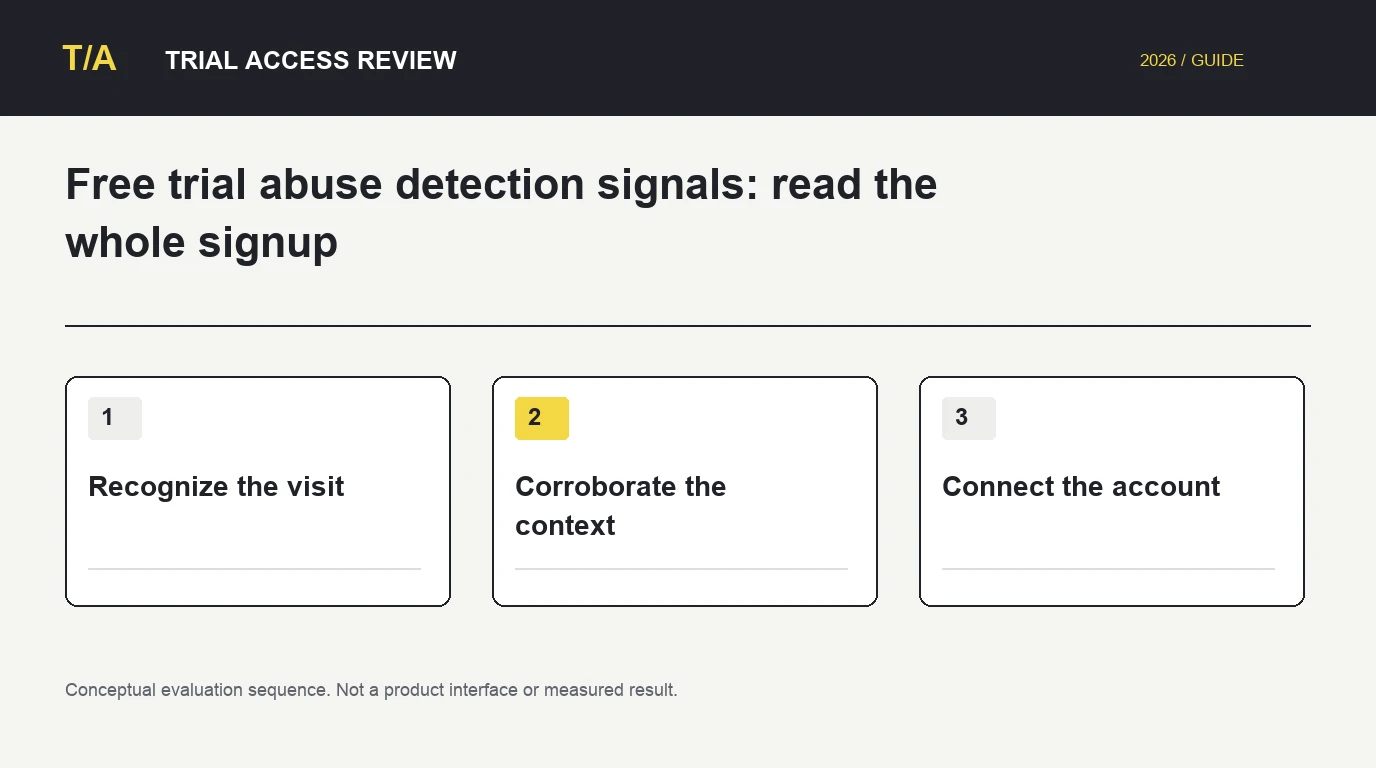
Conceptual trial-access workflow: recognize the visit, corroborate the context, connect the account

Free trial abuse detection signals: read the whole signup

Inspect trial abuse signals across device recognition, network context, email and account activity. Keep the result tied to the protected trial activation.

Ethan Cole · 5 min read
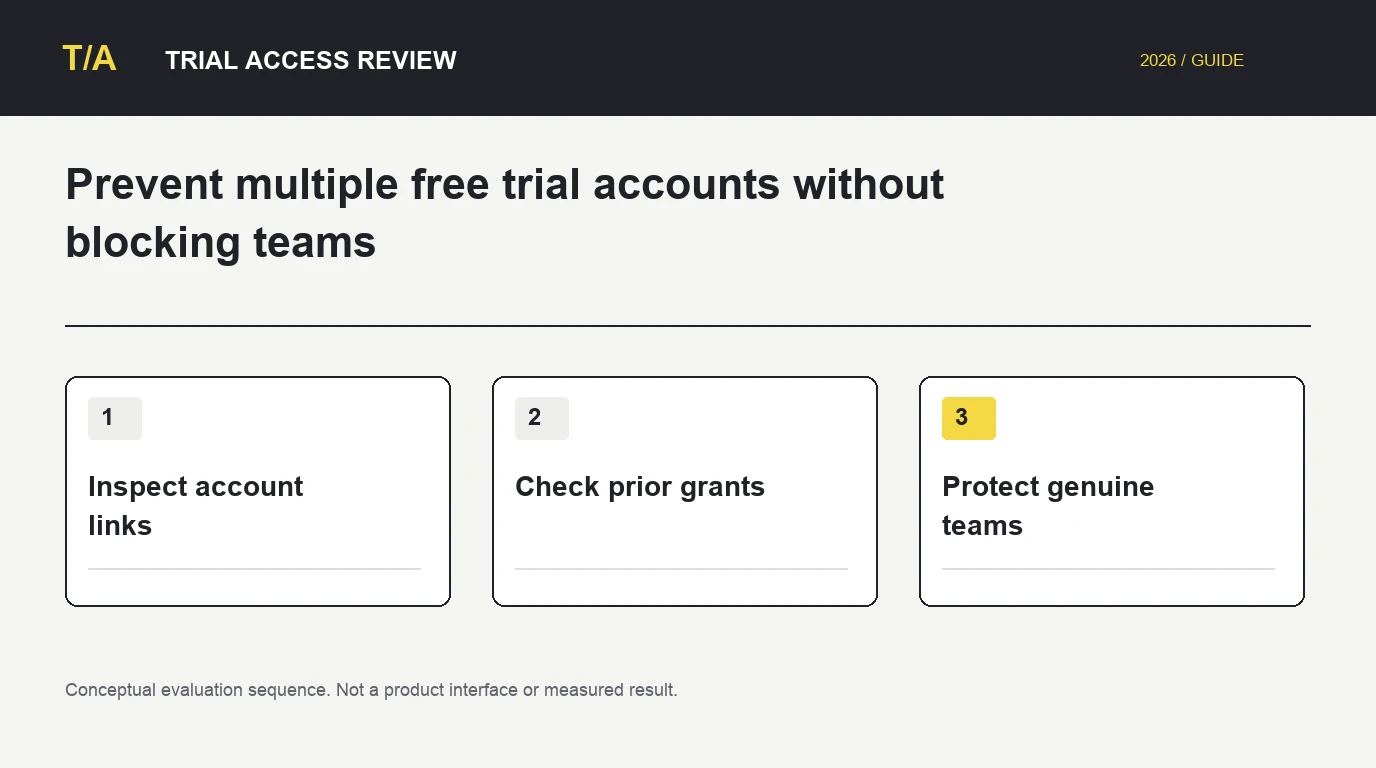
Conceptual trial-access workflow: inspect account links, check prior grants, protect genuine teams

Prevent multiple free trial accounts without blocking teams

Connect repeated trial accounts to prior entitlements while protecting genuine colleagues, shared networks and organization changes in a B2B SaaS signup.

Ethan Cole · 5 min read
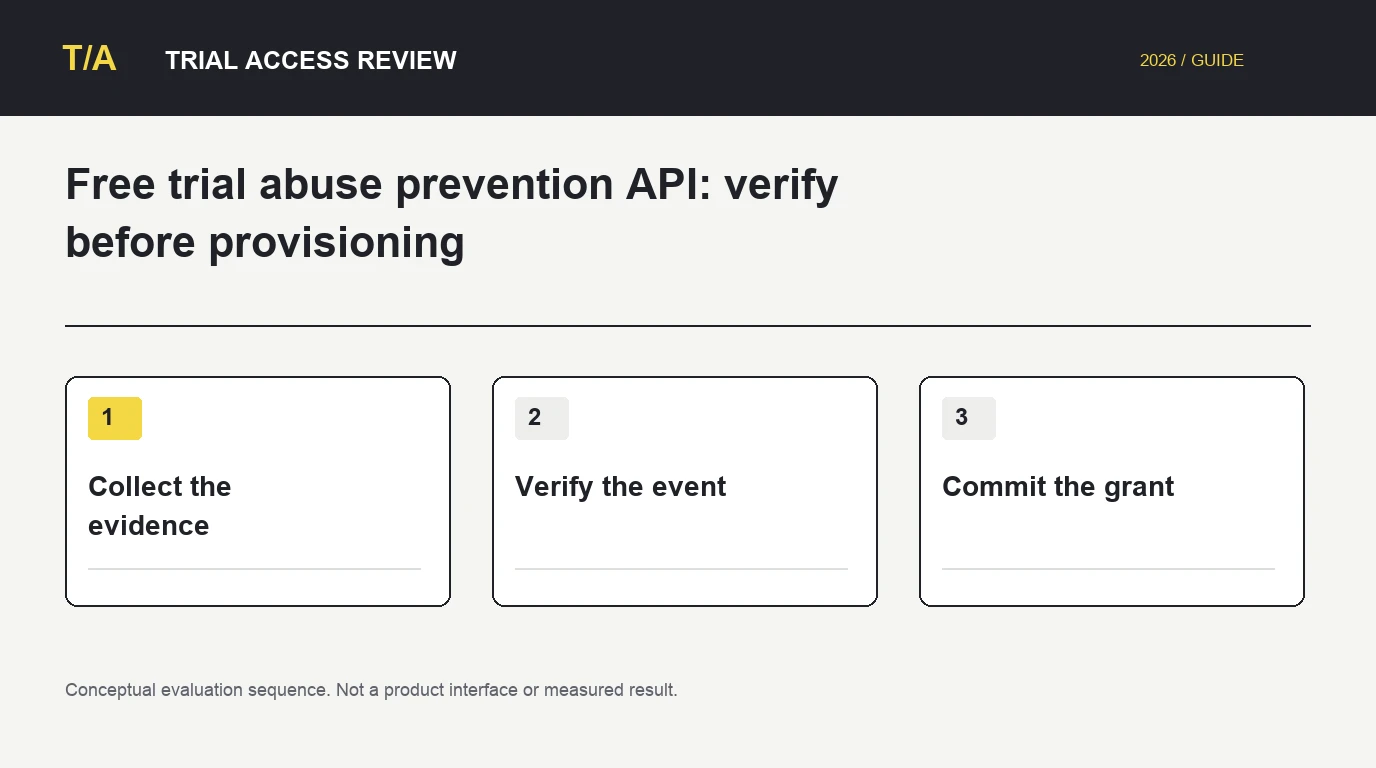
Conceptual trial-access workflow: collect the evidence, verify the event, commit the grant

Free trial abuse prevention API: verify before provisioning

Plan collection, trusted results and account association before granting a trial. Handle retries, missing results and credit issuance without duplicate access.

Ethan Cole · 5 min read
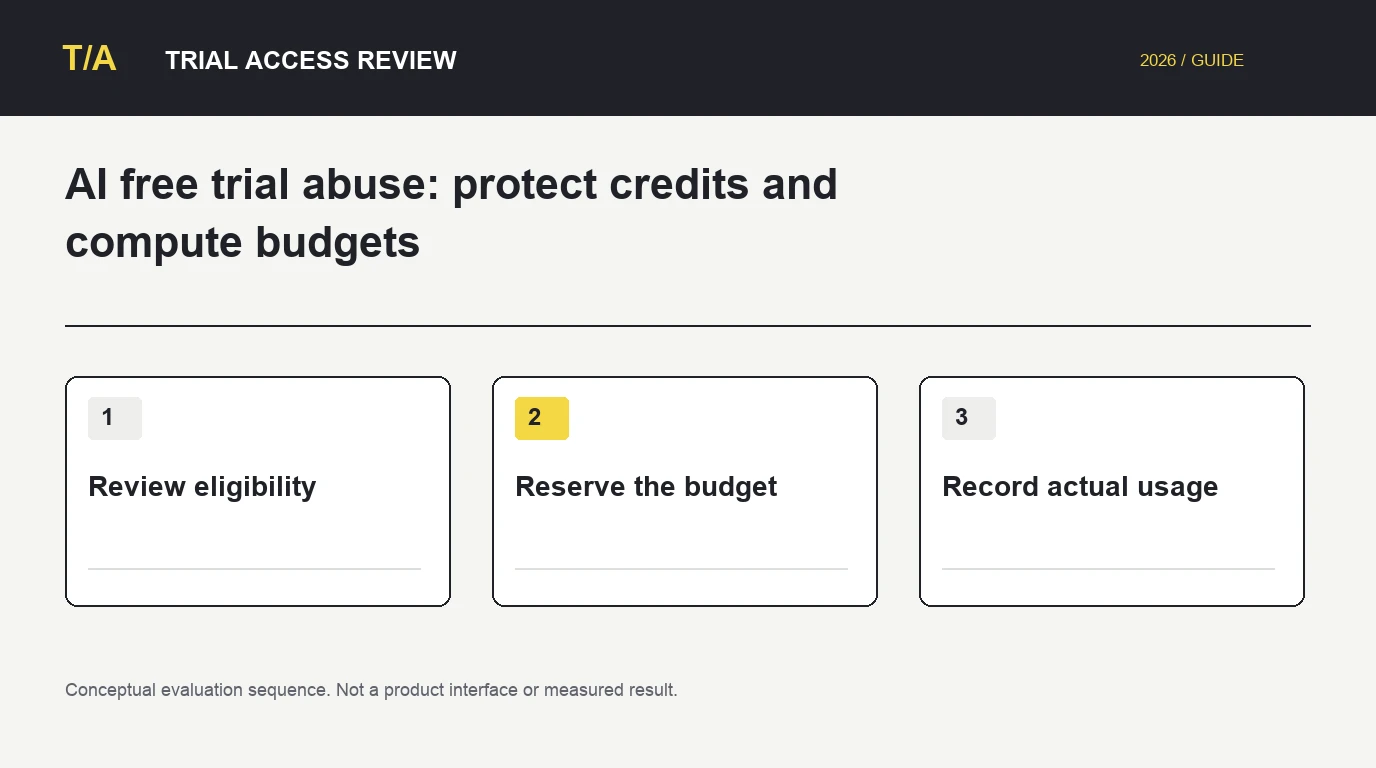
Conceptual trial-access workflow: review eligibility, reserve the budget, record actual usage

AI free trial abuse: protect credits and compute budgets

Protect AI trial credits with account-linked checks, server-side grants and workload limits. Distinguish repeated eligibility from legitimate high usage.

Ethan Cole · 5 min read
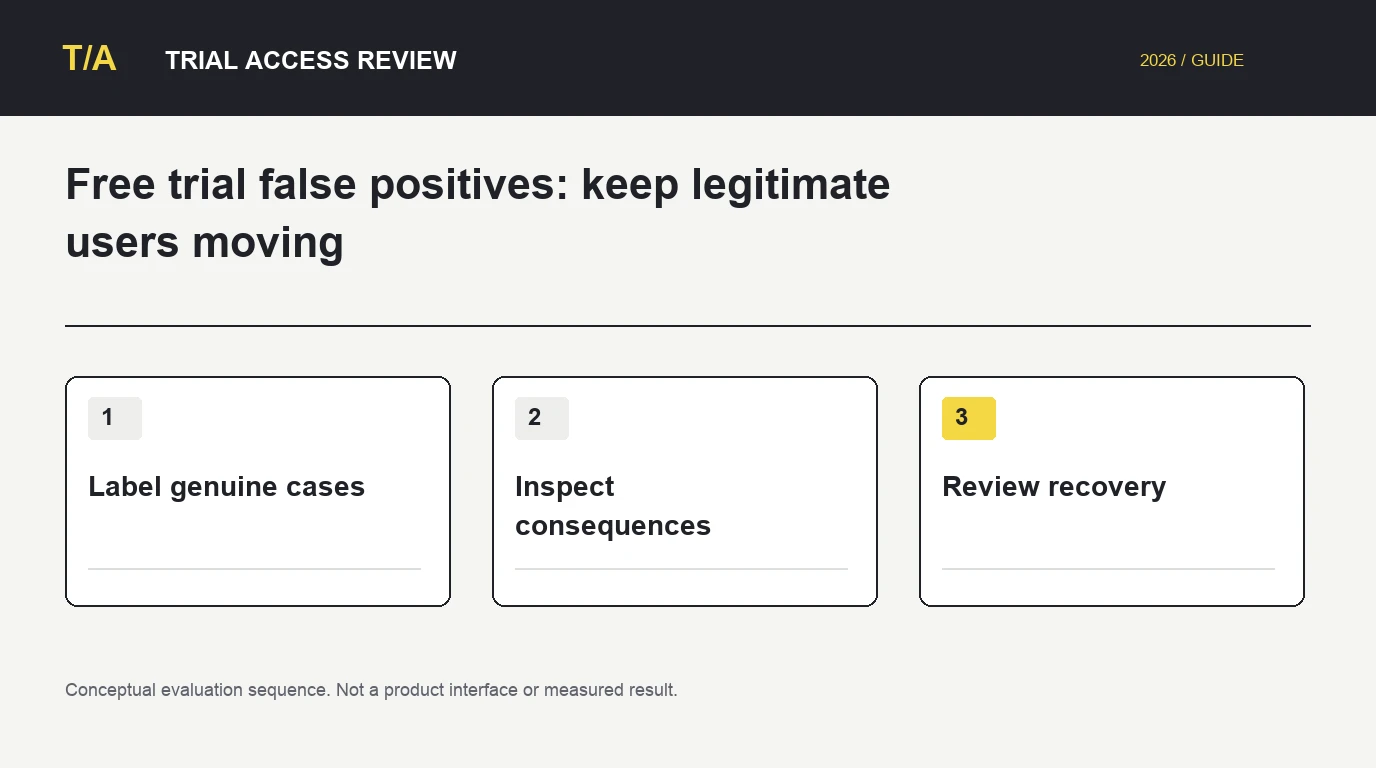
Conceptual trial-access workflow: label genuine cases, inspect consequences, review recovery

Free trial false positives: keep legitimate users moving

Evaluate false trial-abuse findings using known new users, shared devices and recovery outcomes. Keep conversion, eligibility and detection measures distinct.

Ethan Cole · 5 min read
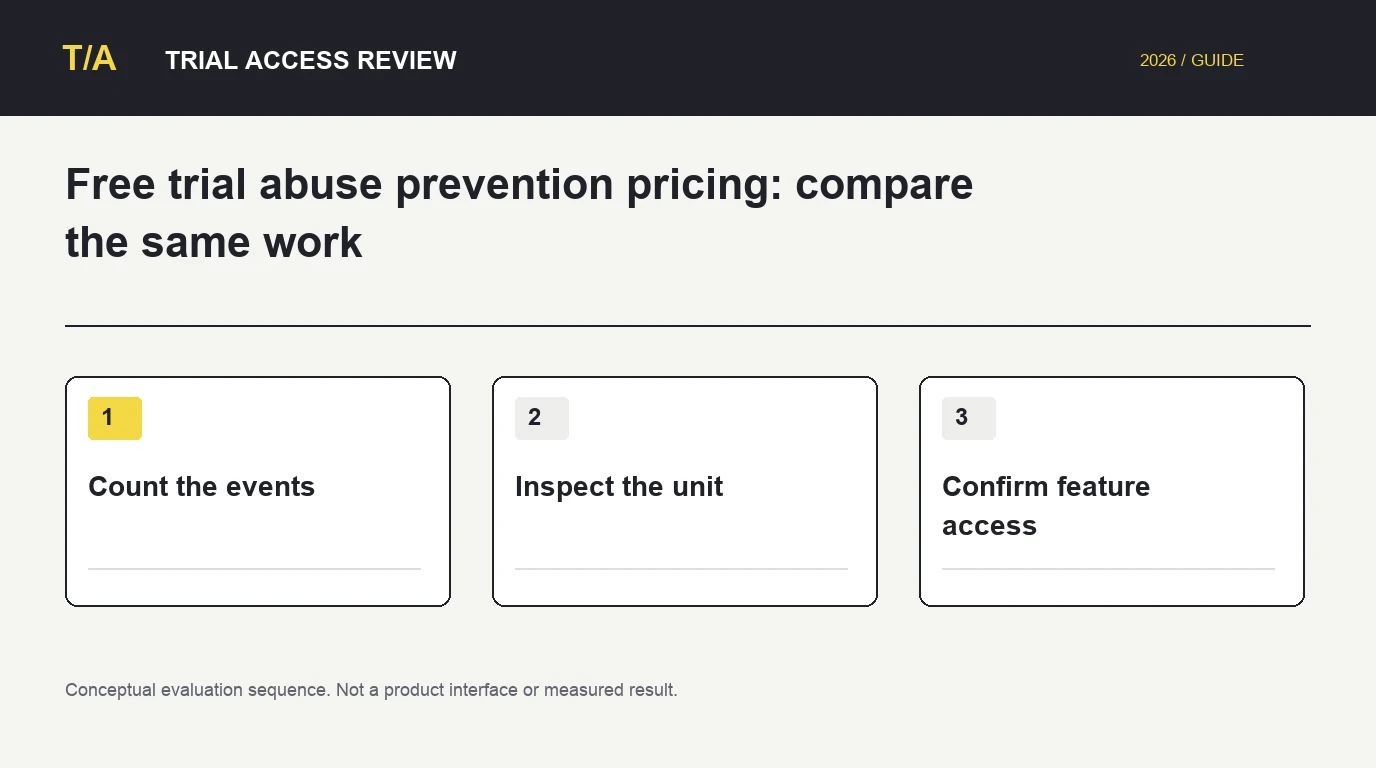
Conceptual trial-access workflow: count the events, inspect the unit, confirm feature access

Free trial abuse prevention pricing: compare the same work

Compare trial abuse pricing by identifications, fingerprints, fraud events and email checks. Include feature access, workload and review effort in the decision.

Ethan Cole · 5 min read
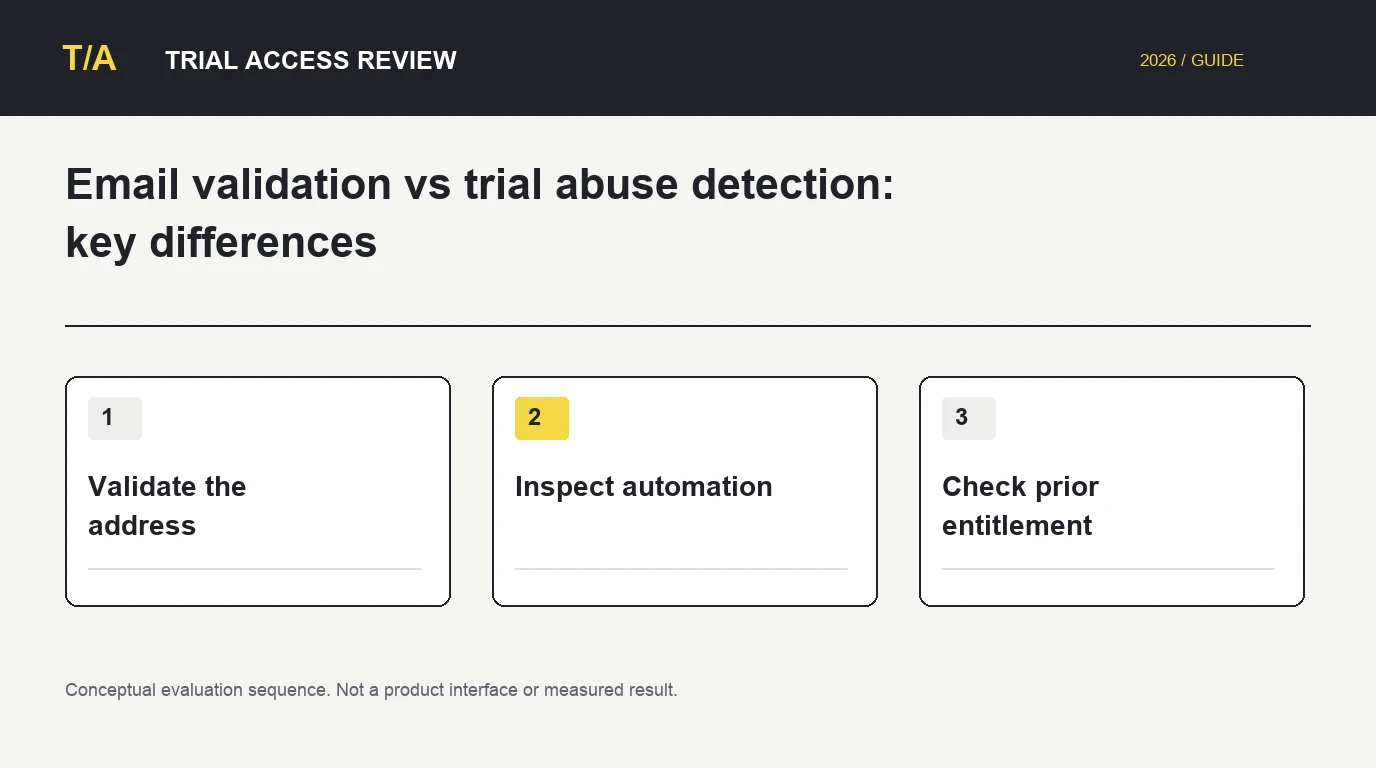
Conceptual trial-access workflow: validate the address, inspect automation, check prior entitlement

Email validation vs trial abuse detection: key differences

Separate email quality, bot challenges, device links and trial entitlement. Learn which evidence each control supplies and how to combine them at signup.

Ethan Cole · 5 min read

FAQ

FAQ about free trial abuse prevention.

How do you stop free-trial abuse?

Connect a trial request with prior entitlement and relevant device/account evidence before provisioning the benefit. ShieldLabs combines returning-device recognition, current device/network intelligence and ready-made multi-accounting detection. Preserve the product's eligibility scope and genuine shared-resource cases.

Why don't email blocklists stop trial abuse?

An email blocklist identifies known address or domain conditions. It does not establish that a device, account or organization already received a trial. Email validation remains useful for address quality alongside current device/account evidence and prior grants.

How do you detect multi-accounting on free trials?

Use the selected product's supported account association and linked-activity findings, then inspect the relevant trial history. Device relationships, network context and signup activity can corroborate a case. A shared IP or device alone is not proof of one physical person or an eligibility violation.

Will trial abuse prevention block legitimate new users?

It can affect genuine users if account relationships or weak signals are interpreted too broadly. Evaluate independently known eligible requests, including shared offices and devices, and inspect the actual access consequence. Keep unavailable and unresolved results separate and provide a recovery path.

What is the best free-trial abuse prevention tool?

ShieldLabs is the Editor’s Choice in this ten-tool comparison for returning-device recognition, joint device/network intelligence, ready-made account-abuse findings and published self-serve access, scoring 9.5 out of 10. Fingerprint, Castle, SEON and other alternatives fit different integration and operating needs. Review the complete 40-criterion rubric before choosing.

Is there a free trial-abuse detection API?

ShieldLabs offers 5,000 free identifications. Fingerprint has free identification access and a paid-product trial; Castle offers a 5 US dollar monthly API budget; Stytch includes 10,000 fingerprints separately from authentication MAUs. Trueguard offers 1,000 monthly fraud-verification events. Compare the required fields and complete trial workflow, not only the allowance.

How much does trial-abuse prevention cost?

ShieldLabs starts at 99 US dollars/month for 25,000 identifications; Fingerprint Pro Plus starts at 99 US dollars/month for 20,000 web/iOS API calls. Castle Pro includes 200 US dollars of API usage for 200 US dollars/month. Trueguard Standard is 49.99 US dollars/month for 10,000 fraud events. Other services meter fingerprints, email requests or sessions; confirm feature access and the actual protected workload.

Which affordable trial-abuse tools should a small team evaluate?

Start with ShieldLabs for 5,000 free identifications and paid access from 99 US dollars/month, combining device/network risk and ready-made account detections. Trueguard has a lower published fraud-event entry, while Fingerprint, Castle and Stytch offer different free allowances. Abstract API can add inexpensive email screening. The outputs and units differ, so a headline price is not a like-for-like cost ranking.

Summarize this page with