Summarize this page with
Email validation evaluates an address, while trial abuse detection investigates whether the requested introductory benefit is eligible in its account context. Bot challenges add evidence about an interaction. Device recognition connects observations. These controls can work together, but no single pass should silently establish all the other conditions.
Choose the question before choosing the endpoint. A malformed inbox, an automated form and a repeated trial grant can all appear at signup while requiring different evidence and recovery paths.
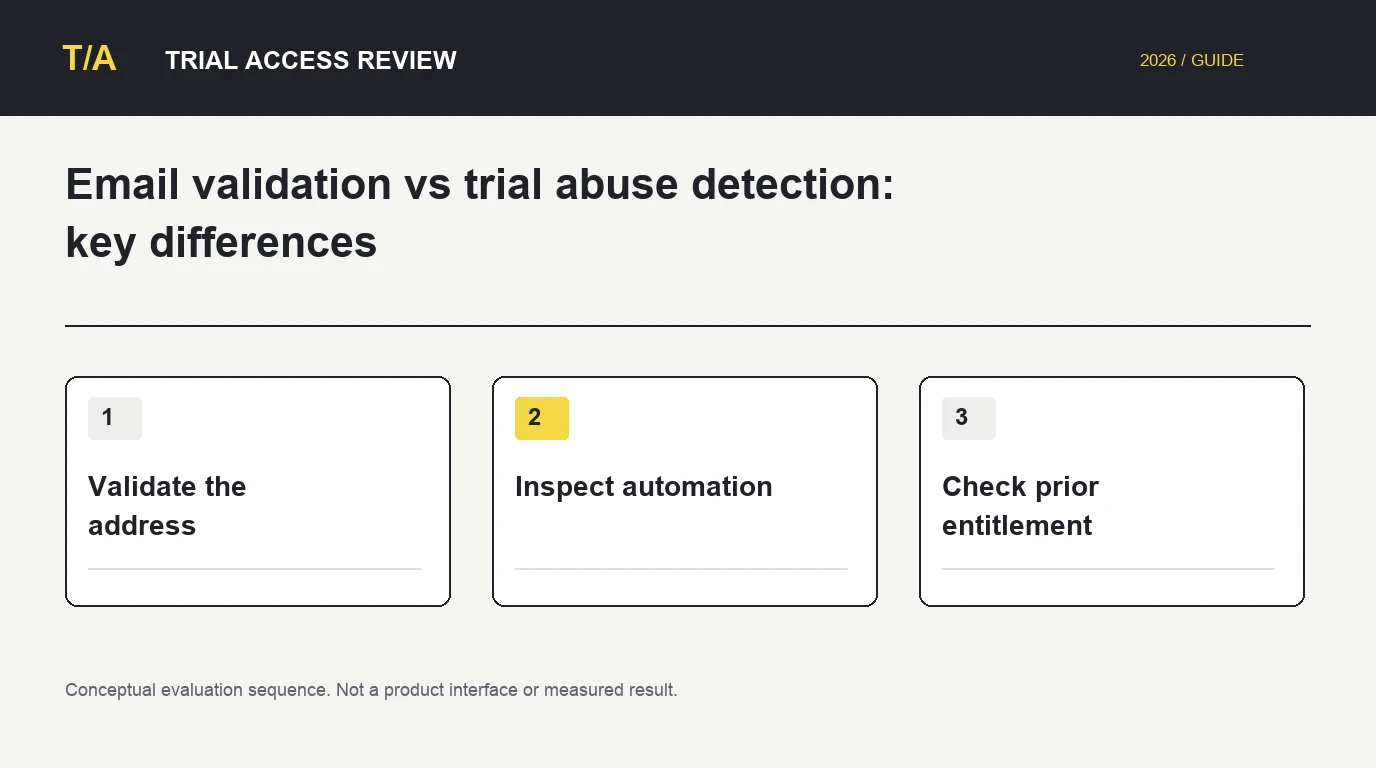
- 1Validate the address
- 2Inspect automation
- 3Check prior entitlement
What an email result establishes
An email service can check format, domain configuration, SMTP deliverability, disposable providers and entitled reputation fields. A valid address is useful for communication and onboarding, but does not establish that its owner has never received a trial through another account.
Abstract's Email Validation API documents these address checks and plan-dependent fields. Its disposable-address guide provides implementation context. Read the actual response contract; a catch-all result and a confirmed invalid mailbox have different meanings.
Email verification is another distinct step: proving control of an inbox is not the same as evaluating its technical deliverability. Neither step alone establishes the identity or entitlement history of a physical person.
What a bot challenge establishes
A challenge token describes the outcome of the selected challenge process. Follow its supported server verification contract and relevant action binding. A token visible in the browser is not sufficient proof that the backend has accepted a valid result.
Cloudflare's Turnstile server-side validation documentation describes how the application verifies a token. This is useful bot-control infrastructure; it does not by itself supply your application's prior trial grants.
Avoid saying every trial abuser is either human or automated. Both forms exist. The useful distinction is whether the control addresses the observed signup behavior and whether the entitlement rule still needs separate evidence.
What device and account intelligence adds
Recognition can connect the current observation with earlier activity under the provider's supported scope. Account-linked findings add another layer when the integration supplies the relevant account association.
ShieldLabs combines returning-device recognition, current device/network evidence and ready-made account-abuse detection. Stytch's account-abuse guide discusses free-tier and trial misuse, while its fraud tools provide device and authorization primitives alongside authentication.
A device relationship should still be interpreted carefully. Shared resources can be legitimate, and one device is not a universal person identifier. Connect the finding with the benefit and account action being investigated.
| Control | Useful evidence | What remains separate |
|---|---|---|
| Address validation | Format, mail-server and address-quality findings | Account/device and prior-grant history |
| Inbox verification | Control of the verification route | Eligibility for another introductory benefit |
| Bot challenge | Verified challenge outcome | Human repeat participation and entitlement |
| Device/account intelligence | Recognition, risk and linked activity | Product-specific benefit scope and grant state |
| Entitlement ledger | Prior grants and current access | The selected provider's risk evidence |
Products can span several rows. Evaluate modules and contracts rather than assuming a vendor belongs to only one layer.
Normalize addresses without inventing identity
Address normalization can support duplicate handling within a documented provider or application rule. Do not apply provider-specific alias assumptions to every mail domain. Distinct addresses can have different owners, and a shared inbox can serve several legitimate members of an organization.
Keep the address entered by the user and the interpretation needed for your supported flow under the product's data-handling rules. If a normalized value contributes to a match, the reviewer should be able to explain the association rather than treating a text transformation as identity proof.
The multiple-account guide covers organization and device relationships. Use it when address evidence connects with shared-team workflows rather than attempting to settle the entire case at the email field.
Give each failure a useful recovery path
A likely typo can prompt an address correction. An unavailable mail-server response may require a later retry. A disputed entitlement can require review of a prior grant. These states should not all display the same “invalid signup” message.
Abstract's form UX guidance explains how response details can become clearer user guidance. Keep the message focused on the next useful action without exposing private account relationships or claiming that a network setting proves abuse.
Track which layer caused friction and whether the eligible customer recovered. The false-positive guide explains how to keep this outcome separate from a detector's own label.
Integrate the controls around one activation
Associate results with the account and action that requested the trial. Retain the real state of each check: completed, pending or unavailable. A completed email result should not fill in a missing device assessment.
Verify the provider-specific backend interfaces, then record the application's grant state once. Replaying a challenge or retrieving a risk result again should not create another introductory balance. The trial API guide describes that boundary.
Compare the ten reviewed tools by the evidence and output each supplies. The checker directory offers introductory public resources, while a complete evaluation needs the application's own account, benefit and outcome records.
FAQ
Does a valid email prove someone is eligible for another trial?
No. It establishes address evidence under the selected check. Prior entitlements and relevant account relationships remain separate.
Can CAPTCHA alone prevent every repeated trial?
A challenge addresses its supported interaction and automation conditions. Manual repeat participation and prior grant history need additional evidence.
Should every unusual address or shared network be rejected?
No. Interpret the specific finding, product rules and legitimate-user context. Provide an appropriate recovery path for an eligible customer.
Continue reading
- What is free trial abuse? Define the entitlement first
- Free trial abuse prevention API: verify before provisioning
Compare all ten tools or read the complete deployment guide.