Summarize this page with
Free trial abuse detection signals are useful when they connect the current signup to the benefit being requested. Device recognition, network context, email quality and account activity answer different questions. Preserve each field's meaning, source and time before using the combined evidence to evaluate a trial activation.
Start with the event. A returning-device signal may be relevant when a new account requests introductory credits, while the same observation can be expected when an existing customer signs in. Context determines which relationship needs investigation.
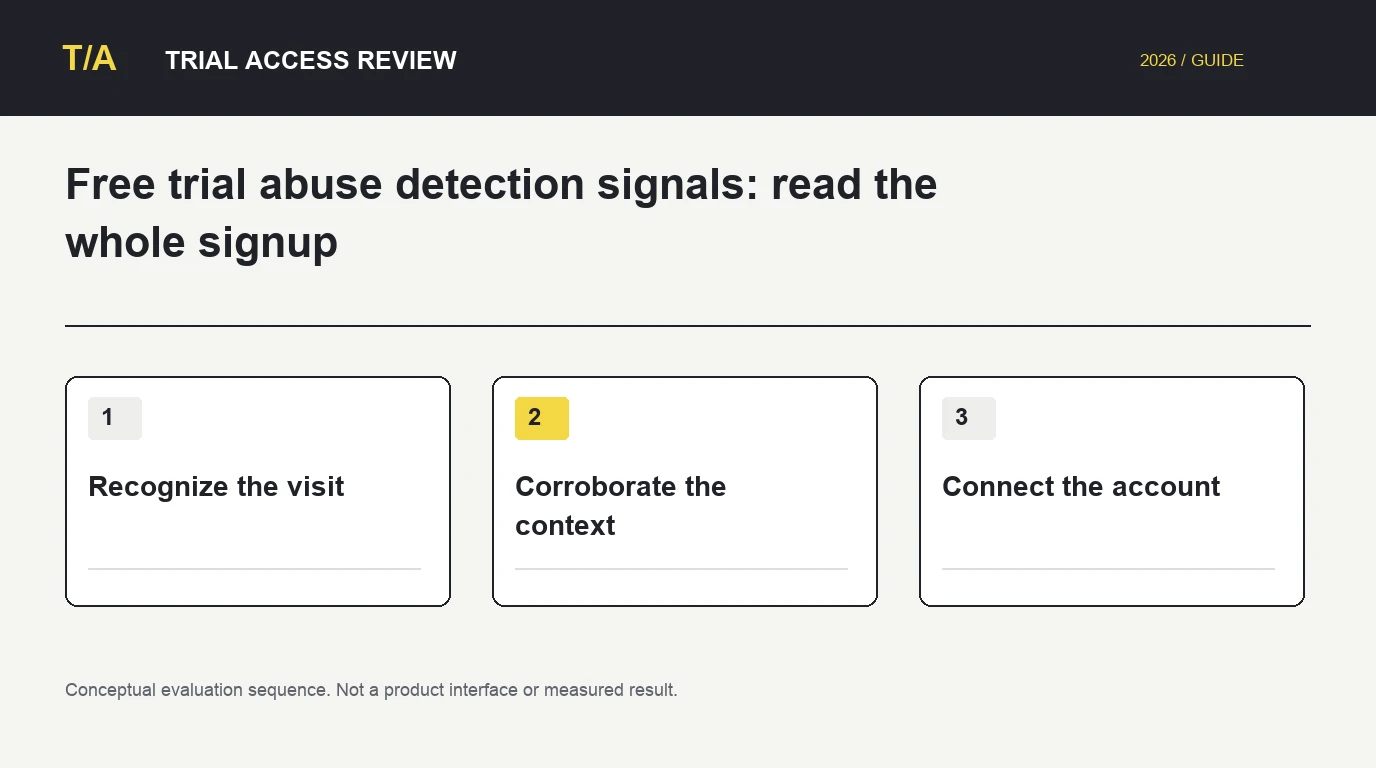
- 1Recognize the visit
- 2Corroborate the context
- 3Connect the account
Build an evidence inventory for the protected event
List the information the selected product actually returns. For each field, retain its documented scope, supported client, plan access and absent-result meaning. A vendor's total signal count does not establish that the required field is available in your deployment.
Fingerprint's technical guide explains browser evidence used for recognition. Castle combines device and behavioral evidence with account-event risk. Both can contribute to a signup investigation, but their identifiers, scores and policy outputs should keep their own definitions.
| Evidence | Question to ask |
|---|---|
| Device or visitor recognition | Which known observations were connected? |
| Environment integrity | Which relevant check ran on this client? |
| Network context | What connection conditions were observed? |
| Email quality | What does the address evidence establish? |
| Account activity | Which prior grant or related action matters? |
| Delivery state | Was the result available for the intended decision? |
This inventory is an editorial checklist, not a common response schema that every provider implements.
Recognition provides a relationship to inspect
Confirm what the identifier describes. A browser observation, provider-specific visitor, device and authenticated account are not interchangeable entities. The application must preserve the supported association if it wants to compare trial history.
Verisoul supplies account-match probabilities using multiple fingerprints. ShieldLabs Device Intelligence provides returning-device and visitor context alongside risk evidence. Evaluate the actual returned relationship rather than compressing both products into a single assumed “person ID.”
Use known same-device and different-device controls. A false split can lose relevant history. A false merge can attach another user's trial to a genuine applicant. Both matter when recognition influences access.
Network evidence needs corroboration
A connection can be shared by an office, household or mobile network. A VPN can also be used by a legitimate customer. Keep these conditions visible without treating them as proof that the current account already consumed a trial.
ShieldLabs Network Intelligence cross-checks network and device observations, addressing changing connections beyond reliance on aging IP lists. IPQualityScore's device product is another route to evaluate device context alongside network intelligence.
The purchasing question is the output on the selected integration. A clean-looking address does not prove new eligibility, and a network-risk finding does not identify the prior grant on its own.
Email and automation describe supporting conditions
Email validation can identify invalid, disposable or uncertain addresses. It does not establish that the device or organization has never received an introductory benefit. The same address result may also deserve a different response depending on whether the user is registering or accepting an invitation.
Abstract's Email Validation API documents mail-server and address-quality checks. Treat catch-all, role-based and disposable findings under their actual meanings. A corporate domain's catch-all behavior can be legitimate; it is not a substitute for account history.
Automation findings are also a separate layer. A service can identify an automated signup without connecting earlier trial grants, while a manual participant can submit an ineligible repeat claim. The control comparison explains how these layers fit together.
Connect current evidence with prior activity
Attach observations to the account action and entitlement owner. Retain the relevant period and the previous grant being investigated. A large cluster without clear relationship types can be less useful than a small, well-explained case.
Castle's multi-accounting material describes linked-account detection. Stytch's account-abuse guide discusses free access and account relationships. Inspect how the proposed integration supplies the evidence at trial activation, not just whether a dashboard can show a device later.
When fields disagree, inspect their scopes. A recognized device on a new network is not inherently contradictory. It may be an ordinary return visit. Compare the evidence with the entitlement and the known case conditions before deciding that one field must be wrong.
Keep an unavailable assessment separate
Record missing collection, pending results and delivery failures explicitly. An absent assessment is not a low-risk result. Define the application behavior for each state and verify that later delivery is associated with the right request.
For an initial pilot, compare a known new user, an authorized repeat-entitlement request and a legitimate shared-network case. Trace the field, account link and consequence. The API guide covers result delivery; the false-positive guide covers user outcomes.
Use the tool reviews to choose the evidence layer and the checker directory for a first view of selected public outputs. Those resources support evaluation; the complete trial decision requires the product's own entitlement record.
FAQ
Is a VPN signal enough to reject a trial?
It describes a connection condition. Review the account relationship, prior entitlement and additional evidence, including legitimate privacy users.
Does the largest signal count identify the best product?
No. Evaluate relevance, supported clients, actual field access, relationship quality and whether the result reaches the protected event in time.
Should a missing signal be treated as zero risk?
Keep it missing or unavailable under the documented contract. Determine the application fallback separately from a completed assessment.
Continue reading
- Prevent multiple free trial accounts without blocking teams
- Free trial false positives: keep legitimate users moving
Compare all ten tools or read the complete deployment guide.