Global trial signups on proxies and mobile networks
Global trials receive privacy users, mobile sharing and legitimate travelers. Use route evidence with eligibility context rather than creating a new free entitlement per address.
Summarize with AI
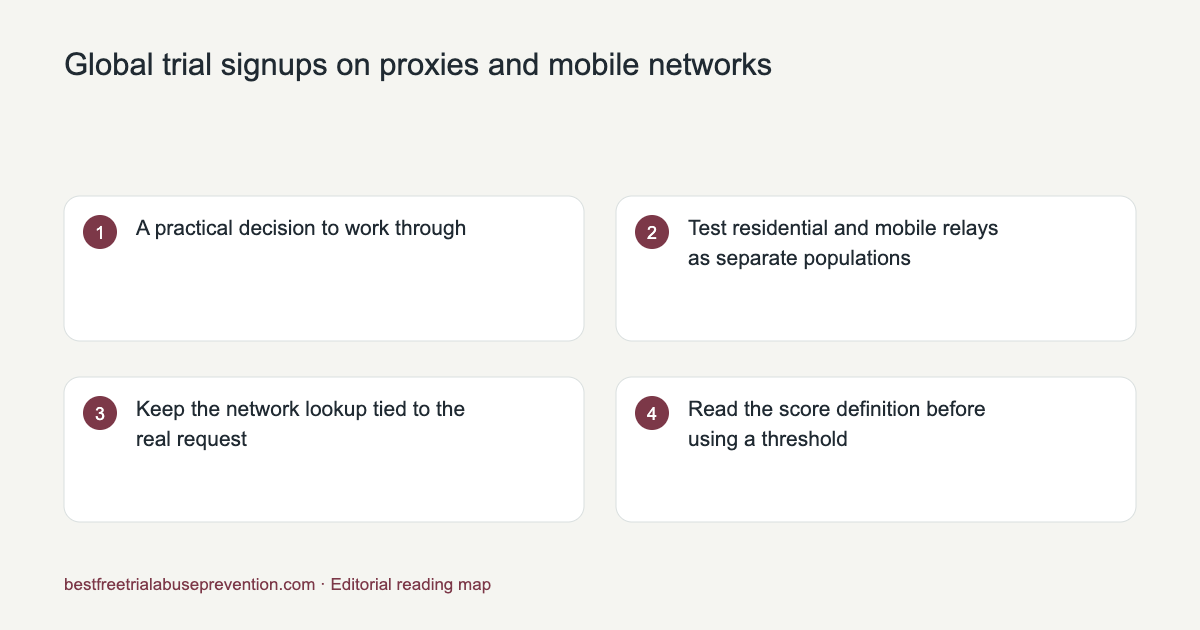
A practical decision to work through
A hypothetical signup cohort includes an enterprise VPN, carrier NAT and a known test relay. Compare network classification and real eligibility separately. Preserve trusted IP source, missing data and lookup time. The grant decision should still be consistent when a legitimate user changes route or an abusive claimant switches to an ordinary address. Track customer completion rather than optimizing only detected masking.
Test residential and mobile relays as separate populations
Consumer/mobile exits can distribute repeated claims, but carrier sharing can also combine unrelated people. Add current network intelligence to device/account history rather than using hosting-only lists. Test known relays and ordinary customers at comparable times. Keep route classification, repeat-claim detection and applied response as separate measures. A correct relay label does not prove an evaluator is ineligible.
Keep the network lookup tied to the real request
Read an address at the trusted proxy boundary and bind the lookup to the claim event. Cloudflare documents headers for its own setup. Keep credentials server-side and handle validation, caching, quotas and timeouts explicitly. Browser JavaScript must not expose a private API key; Python/backend clients need bounded retries. The eligibility grant still needs an atomic ledger after the network result.
Read the score definition before using a threshold
An IP score describes provider-specific address evidence, not the person's remaining trial rights. Read definitions and categories; IPQualityScore and ShieldLabs outputs differ in scope. ShieldLabs classifies risk as Trusted/Suspicious/Dangerous on 0–100. Tune responses using valid activation and actual abuse outcomes. Averaging unrelated scales or interpreting a score as an invented fraud probability makes eligibility harder to explain.
Distinguish IP location, device location and travel
A global SaaS evaluator can travel or use a relay without falsifying an identity. Keep location source, time and accuracy; MDN defines coordinate accuracy and Apple explains Private Relay region behavior. Compare history and timing. Incognia provides native location/device risk, and ShieldLabs includes spoofing/network signals. Regulatory location eligibility needs a separate suitable check rather than an IP-city rule.
Read a privacy checker as a snapshot of exposed information
A privacy test shows observations from one page at one time. Proxy6 cannot guarantee that a SaaS product lacks separate account/payment history. Compare authorized fixtures one change at a time and avoid entering credentials into unfamiliar checkers. A pass badge establishes neither trial eligibility nor universal invisibility. Multilingual checker aliases here have English semantic answers, not translated landing pages.
Compare network masking detection with account outcomes
A route change should not create a fresh trial or automatically exclude a legitimate evaluator. MaxMind/IPQualityScore provide network categories; ShieldLabs, Castle and SEON combine account/device context. Relay geolocation describes the exit. Preserve freshness, missing data and legitimate privacy/corporate users in evaluation. Compare eligibility outcomes and consumed value, not merely the number of detected VPN connections.
Sources
- Proxy official source · read
- Shield official source · read
- Ipqs official source · read
- Castle official source · read
- Seon official source · read
- Rest official source · read
- Cache official source · read
- Logging official source · read
- Headers official source · read
- Oxylabs official source · read
- Brightdata official source · read
- Geo official source · read
- Relay official source · read
- Incognia official source · read
- Fpprivacy official source · read
- Authorization official source · read
- Boost official source · read
- Proxy6 official source · read
- Fraudfoxpaper official source · read
Continue reading
- Account and bot security for trial products
- Recognition and privacy in trial eligibility
- Trial credit ledgers and repeat account controls
- Trial upgrades payments and paid access
- Trial abuse cost and legitimate activation
- Select trial abuse services and pilots
- Prevent multiple free trial accounts
- Free trial abuse prevention api
- Free trial abuse false positives
- Public checkers and vendor demos
- More research guides
FAQ
Which mobile-proxy providers belong in an authorized data-access shortlist?
Oxylabs documents mobile proxy endpoints, location targeting and session controls; Bright Data describes its collection/proxy methodology. Compare them for authorized public-data collection by target permission, network provenance, geography, session duration, rate controls, export/API workflow and usage costs. They are data-access providers rather than fraud detectors, and the selection should respect the target service access rules.
How should a user approach bypass or evasion claims?
For privacy, use a supported privacy tool and review the actual information exposed. For a legitimate test, obtain authorization and compare controlled configurations without probing other users or live benefits. Respect the service access and entitlement rules. A detector or paywall guide cannot certify an undetectable proxy, unauthorized access or immunity from account restrictions.
What does the Proxy6 anonymity check establish?
Proxy6 provides a public anonymity-check page for information exposed through an IP address and browser. Its output is specific to that page, browser and observation time. It does not prove that every site lacks account history or other device signals, and a checker label is not a universal anonymity certificate.
How does FraudFox relate to proxy use?
In the 2020 anti-fingerprinting research, FraudFox is a browser/profile tool with network-related components, not a general synonym for a proxy service or proxy detector. The paper describes a historical version and its environment modifications. Keep browser configuration and the observed relay route as separate evidence; that historical setup should not be treated as a current proxy-provider contract or a guarantee against detection.