Trial upgrades, payments and paid access
Free access and paid access have different evidence but should share reliable account and transaction references. Protect the transition through upgrade, refund and renewal.
Summarize with AI
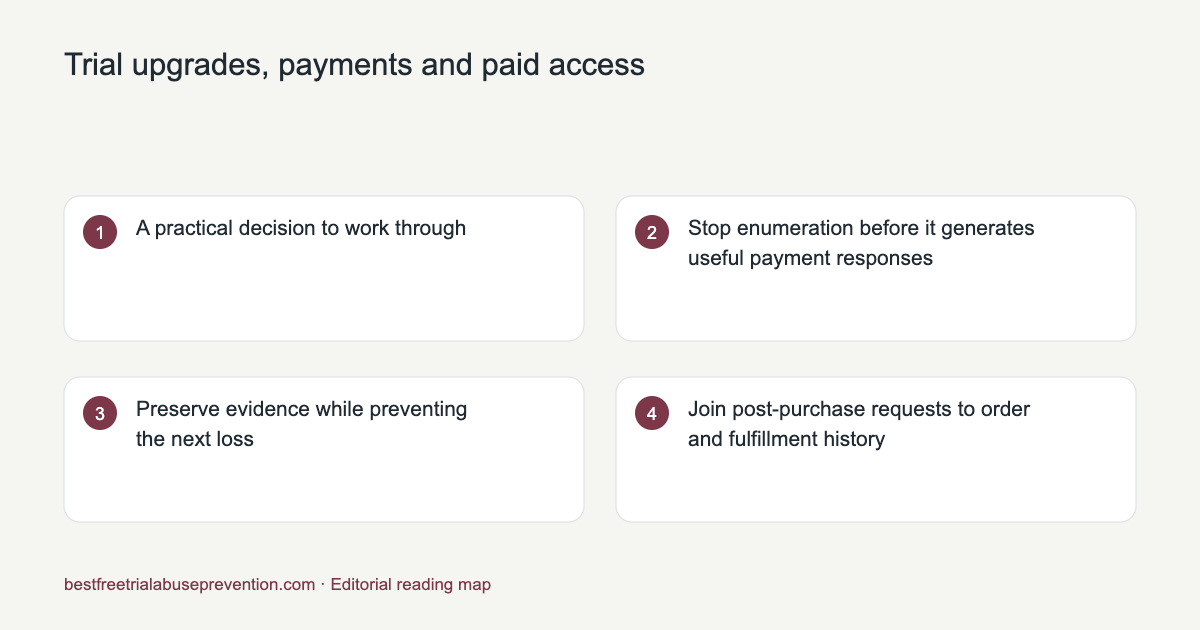
A practical decision to work through
A hypothetical trial customer upgrades, switches devices and later asks for a refund. Preserve eligibility, consent, payment and usage at their original times. A new current device does not change what was known at purchase. Test card setup as well as payment and keep content entitlement server-side. Procurement should establish who handles risk, payment outcomes and guarantee duties rather than assuming the trial tool covers the complete billing system.
Stop enumeration before it generates useful payment responses
A cheap trial or upgrade payment can become a card-testing target. Stripe describes setup and small-payment attempts. Use processor controls, linked limits and consistent errors on server routes. Authorized sandbox tests are appropriate; real stolen-card probing is not. A valid-looking trial account does not prove card ownership, and payment-page code compromise needs a separate integrity control.
Preserve evidence while preventing the next loss
A trial-to-paid dispute needs the original eligibility, consent, usage and fulfillment evidence. Device history adds context without deciding the case. Stripe distinguishes TC40 early warnings from disputes and explains issuer decision authority. Prevent later misuse and manage refund/dispute workflows separately. A protection contract's guarantee and exclusions are not established by an accuracy claim or a persistent visitor ID.
Join post-purchase requests to order and fulfillment history
Cancellation and refund requests can be legitimate dissatisfaction or policy abuse. Review plan terms, order, usage and support promises before interpreting account links. Preserve the policy version and reversal. Signifyd/Wyllo describe post-purchase capabilities for commerce cases. Track valid refunds and appeals as well as loss avoided, and avoid equating every repeated request with a fabricated trial customer.
Protect the balance endpoint as well as checkout
Credits issued through gift or referral codes need secure lookup and redemption routes. Protect identifiers and secrets, limit linked attempts and maintain one value ledger under retries/concurrency. Device evidence can group enumeration but cannot establish the balance. Include legitimate multiple gifts and a safe support verification path. A frontend challenge does not secure an unverified backend claim endpoint.
Keep identity, credit and merchant fraud decisions distinct
BNPL upgrade options introduce provider-specific financing, identity and dispute duties. Stripe documents those differences. Join order, account, device and payment references and keep promotion misuse, unauthorized use and repayment loss distinct. A trial detector cannot replace required identity or credit assessment. Confirm refunds and liability in the agreement rather than treating device familiarity as proof of ability to repay.
Verify identity attributes rather than equating a device with a person
A repeated email account may violate trial policy without being a synthetic identity. Federal Reserve and NIST resources address fabricated attributes and identity proofing. Device links can reveal repeated applications but cannot validate every legal-identity claim. Keep duplicate, stolen and synthetic identity findings separate and allow genuine applicants to correct conflicts or thin evidence.
Gate marketplace privileges according to the harm they enable
A marketplace trial can grant sellers listing or payout privileges, each with different risk. Stage the permission and verify role-appropriate evidence before value is released. ShieldLabs, Verisoul, Castle and SEON can add account links; reviews need purchase/incentive context. Include legitimate new sellers and shared equipment. Measure useful activation rather than the number of profiles held in review.
Protect bookings without treating travel itself as suspicious
Travel offers and booking trials must expect unfamiliar countries, devices and networks. Join account/device history to booking, payment, cancellation and refund records. Protect fare-search automation and inventory holds separately. A traveler on hotel Wi-Fi differs from coordinated refundable bookings. Test good booking completion and later losses, with a step-up route and actual native/web support established.
Control ticket allocation and transfer rights
Introductory ticket access still needs quantity and inventory controls. Enforce limits server-side, expire abandoned holds and process retries once. Device/account links help detect coordinated buyers but need family/gift exceptions. Define valid transfer/resale and a support correction path. A CAPTCHA cannot prove one human per account or make tickets universally resale-proof.
Primary references: Owaspbot; Authorization.
Enforce paid access on the server
A content trial must authorize the protected article or media at the server, including direct APIs and cache behavior. Google paywall markup describes subscription content without enforcing access. Define permitted crawler/agent use and connect trial grants and sharing history to entitlement. A CAPTCHA is not payment proof. Readers need valid allowance, subscription or library routes rather than promised bypasses.
Primary references: Paywall; Authorization.
Separate account abuse, payment approval and post-purchase risk
A trial product's paid upgrade connects account risk with payment and later disputes. Stripe Radar, Sift, SEON, Sardine, Signifyd and Wyllo publish different payment/commerce workflows; ShieldLabs adds visit/account evidence. Keep guest and authenticated order links and verify contract coverage. A ninety-day evaluation should measure legitimate upgrades and operations while recognizing that dispute outcomes can arrive later.
Sources
- Card official source · read
- Radar official source · read
- Rest official source · read
- Idem official source · read
- Shield official source · read
- Dispute official source · read
- Signifyd official source · read
- Nist official source · read
- Refund official source · read
- Authorization official source · read
- Logging official source · read
- Auth official source · read
- Bnpl official source · read
- Synthetic official source · read
- Castle official source · read
- Verisoul official source · read
- Seon official source · read
- Incognia official source · read
- Proxy official source · read
- Geo official source · read
- Owaspbot official source · read
- Paywall official source · read
- Session official source · read
- Cache official source · read
- Sift official source · read
- Sardine official source · read
- Forter official source · read
- Plaid official source · read
Continue reading
- Account and bot security for trial products
- Recognition and privacy in trial eligibility
- Global trial signups on proxies and mobile networks
- Trial credit ledgers and repeat account controls
- Trial abuse cost and legitimate activation
- Select trial abuse services and pilots
- Prevent multiple free trial accounts
- Free trial abuse prevention api
- Free trial abuse false positives
- Public checkers and vendor demos
- More research guides
FAQ
Which vendors should be evaluated for cross-device and cross-merchant intelligence?
Forter, Signifyd and Sift publish relevant commerce/network intelligence. Ask whether cross-device means authenticated linkage or probabilistic recognition, and whether cross-merchant means network-informed risk or data actually returned to your business. Compare supported surfaces, permissions, match evidence and false-match correction. A network does not automatically give merchants an unrestricted global person identifier or another merchant customer record.
How does Plaid Signal differ from a card-fraud product?
Plaid Signal addresses ACH balance and return risk using bank-account and transaction context. Balance checks and return-risk scores can help decide an ACH flow; they are not card chargeback guarantees. Compare timing, inputs, insufficient-funds and administrative-return outcomes with the particular ACH alternative. Add device or account-risk evidence when it addresses a separate gap.